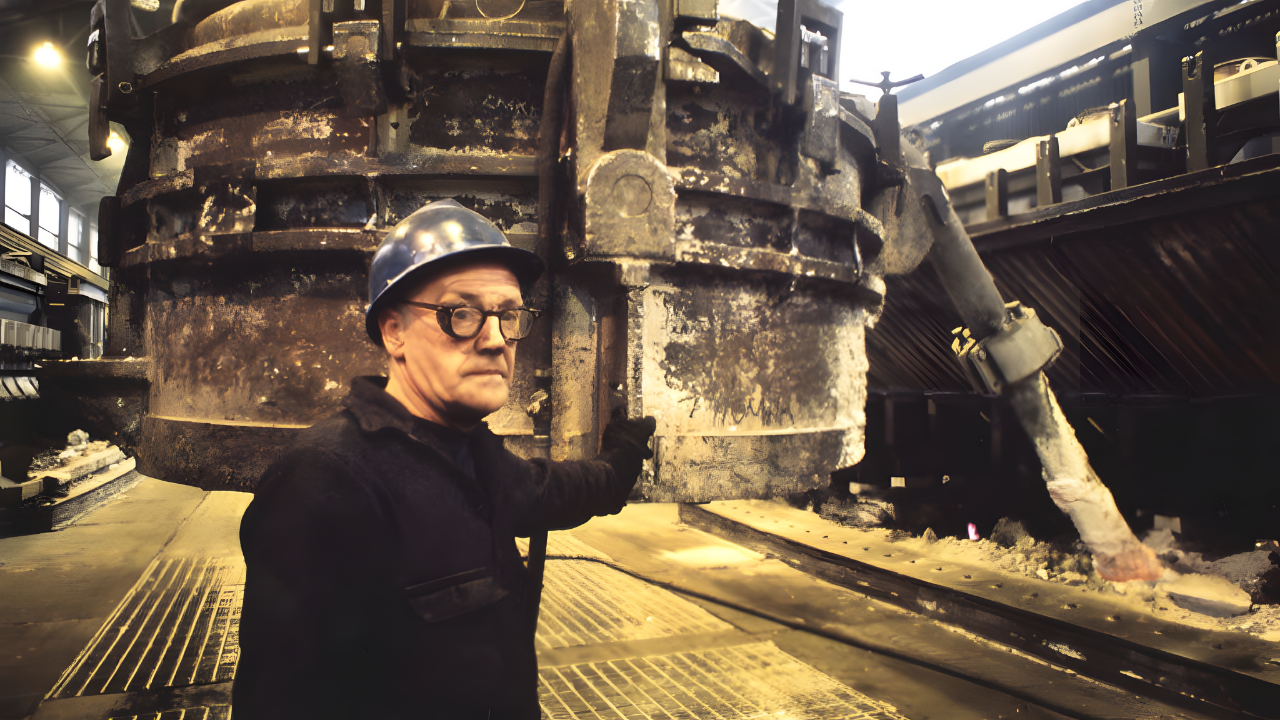
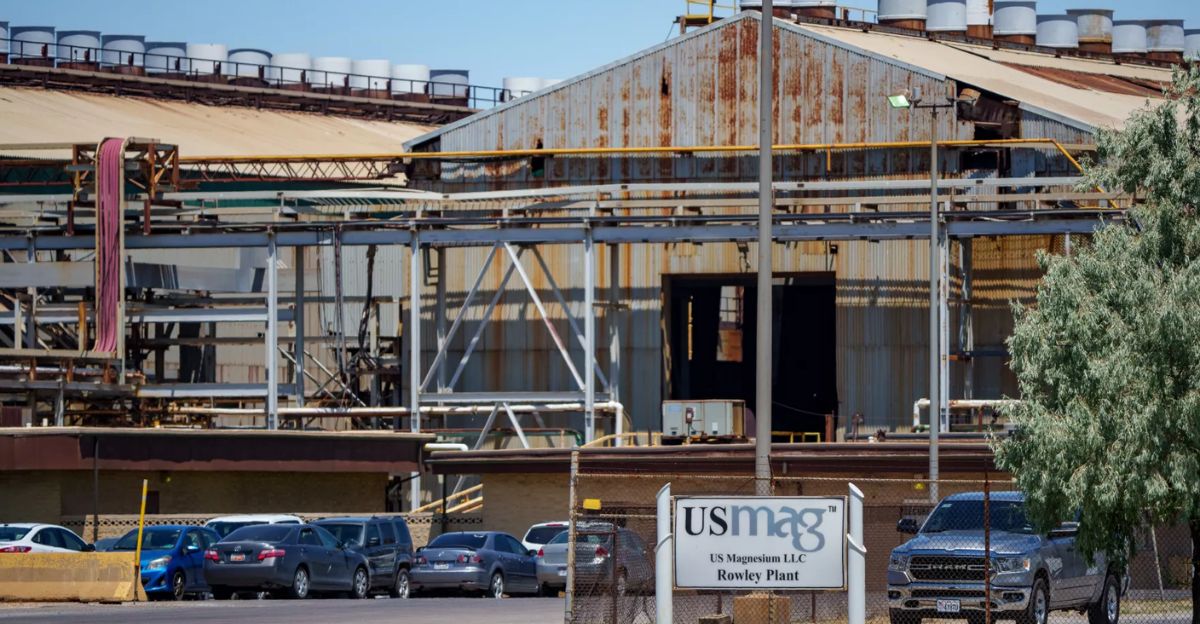
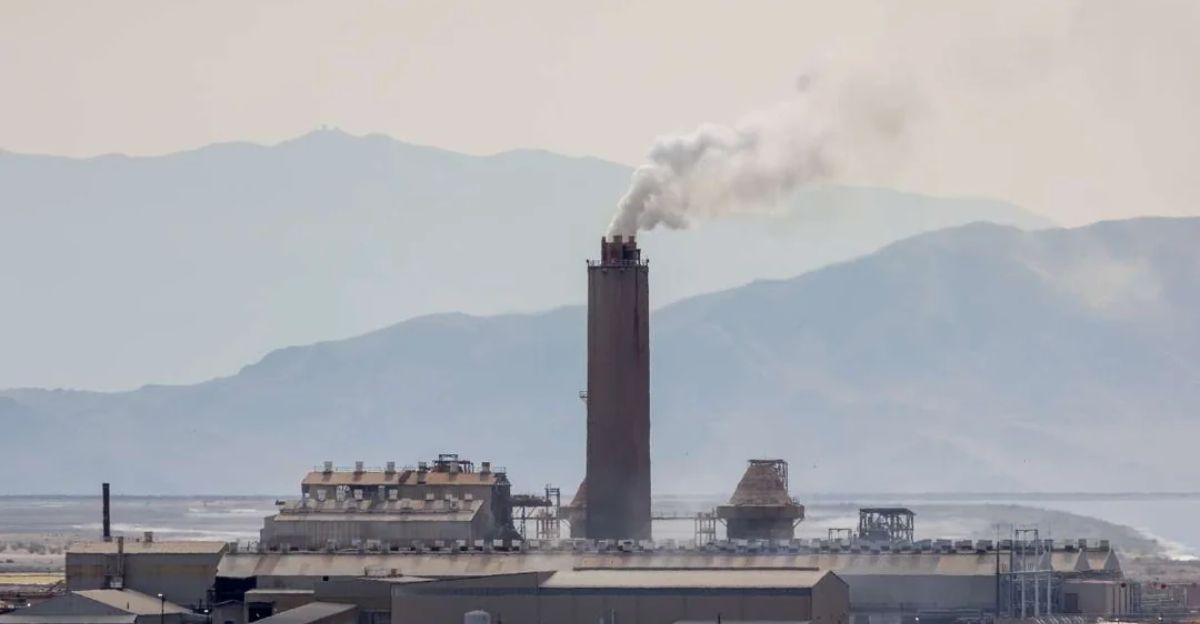
In the shadow of Utah’s Great Salt Lake, a vast magnesium plant once hailed as a symbol of U.S. industrial strength now stands idle—at the center of a deepening environmental and financial crisis.
The operation, spanning 4,500 acres of state-owned lakebed, has shut down and entered liquidation, leaving taxpayers facing a potential cleanup bill exceeding $100 million.
Environmental Damage and Growing Risk
University of Utah geology professor Bill Johnson has spent more than a decade serving as a technical advisor to study contamination at the site, now part of a federal Superfund cleanup. His research reveals that acidic wastewater ponds have corroded berms, contaminated sediments have harmed wildlife, and toxic groundwater plumes appear to be spreading toward the Great Salt Lake.
For years, the facility discharged roughly 630 million gallons of wastewater annually. Johnson estimates that two-thirds of that—over 400 million gallons per year—percolated underground, forming a spreading plume. Only a few monitoring wells line the four-mile stretch of waste ponds, leaving regulators uncertain about how far the contamination has spread.
The sprawling industrial footprint, comparable in size to the city of South Salt Lake, once processed the lake’s briny waters into magnesium metal for cars, wind turbines, and solar panels. Now, the nation’s former largest magnesium producer stands silent, its legacy defined more by toxicity than output.
Pollution, Bankruptcy, and Regulatory Pressure
Federal investigators first intensified their scrutiny in 2001, when the Environmental Protection Agency (EPA) discovered a 2,000-foot-long, 20-foot-deep unlined canal so acidic that workers dubbed it the “Red River.” It emptied into an equally corrosive lagoon. Facing a possible $900 million in penalties, MagCorp, the operator, filed for bankruptcy. Its assets were acquired by billionaire Ira Rennert’s Renco Group, which formed U.S. Magnesium and continued the operations.
By 2009, the area was officially designated a Superfund site. Regulators identified a host of pollutants—acidic wastewater, chlorinated dioxins, PCBs, hexachlorobenzene, lead, arsenic, and chromium—with discharges dating to the 1990s. Despite this, U.S. Magnesium escaped the enormous penalties faced by its predecessor.
On September 10, 2024, exactly 24 years after MagCorp’s collapse, U.S. Magnesium filed for Chapter 11 bankruptcy in Delaware. The company listed over $200 million in liabilities, including $95.4 million to its 20 largest unsecured creditors and $67 million owed to Wells Fargo. Those numbers exclude the EPA’s cleanup projection, which exceeds $100 million.
Public obligations also remain unpaid: $7 million in property taxes to Tooele County, nearly $1 million in EPA administrative costs, and several hundred thousand dollars in royalties to Utah’s Division of Forestry, Fire and State Lands. State officials concluded the company “has not been a good steward of the land.”
Failed Safeguards and Abandoned Containment
To protect taxpayers, a 2021 consent decree required U.S. Magnesium to set aside $16.5 million in financial assurance. The company never provided the final $1.5 million installment and has since requested that the bankruptcy court release those same funds—intended precisely to cover cleanup in the event of default.
The EPA’s containment strategy involved constructing a $10 million barrier wall to block acidic waste from reaching the lake, thereby safeguarding approximately 1,700 acres. Construction began in May 2023 but stopped six months later when the Colorado-based contractor Forgen reported nonpayment. The half-built barrier now stands as a symbol of halted protection efforts while the contaminated groundwater continues its slow underground drift toward the lake.
U.S. Magnesium also attempted to pivot toward lithium extraction from the lake’s mineral-rich brines—an effort to align with the clean-energy transition. But lease disputes and compliance failures killed the project before operations began.
Inside Deals and Legal Challenges
On the same day as its bankruptcy filing, Renco created a new subsidiary—LiMag Holdings, LLC—and proposed it as the “stalking horse” bidder to buy the plant’s assets. Utah regulators saw troubling parallels to the 2001 MagCorp-to-U.S. Magnesium transition: bankruptcy, an insider sale, and environmental liabilities left behind. In court filings, state attorneys warned the company had “gone through this charade previously.”
At the center is Ira Rennert, the 90-year-old billionaire, still valued at $3.8 billion. In 2013, a jury found Rennert liable for diverting company funds to build his $110 million Hamptons mansion; an appeals court subsequently upheld a $213 million judgment. Over decades, Renco’s web of subsidiaries has shielded the parent from operational liabilities. The current bankruptcy could extend that pattern—collapsing subsidiaries while the controlling owner remains protected.
Utah’s Legal Push and Mounting Costs
In December 2024, Utah sued U.S. Magnesium to compel cleanup and revoke its lakebed mineral lease. A district judge appointed a receiver to oversee the company, later narrowing the role to environmental oversight as court actions advanced. Regulators have warned that unless contamination is addressed, U.S. Magnesium will lose access to state lands entirely.
Internal company estimates indicate that resuming production would require $40 million to rebuild magnesium operations and $30 million to $100 million to develop lithium extraction, plus the $100 million or more in remediation costs—creating a total financial hurdle exceeding $240 million.
Future of a Shared Landscape
Community advocates now regard the shuttered plant as a scar on a vital shared landscape. Workers face uncertain jobs and pensions. The unfinished barrier wall, minimal groundwater monitoring, and mounting legal fights paint a bleak picture.
As bankruptcy proceedings and insider bids unfold, Utah’s officials and residents confront a pressing question: With U.S. Magnesium insolvent and cleanup safeguards eroding, will the state’s taxpayers ultimately bear the cost of a toxic inheritance on the shores of the Great Salt Lake?
Sources:
“The country’s biggest magnesium producer went bankrupt,” Grist and Salt Lake Tribune, December 2025
“Legacy Contamination at the US Magnesium Superfund Site,” FRIENDS of Great Salt Lake, 2025
“US Magnesium bankruptcy delays state plans to cut off Great Salt Lake water,” Great Salt Lake News, September 2025
“Case Summary: US Magnesium Chapter 11,” BondOro, September 2025
EPA Settlement and Barrier Wall Documentation, U.S. Environmental Protection Agency, February 2024
“Jury: Billionaire Ira Rennert looted MagCorp,” Salt Lake Tribune