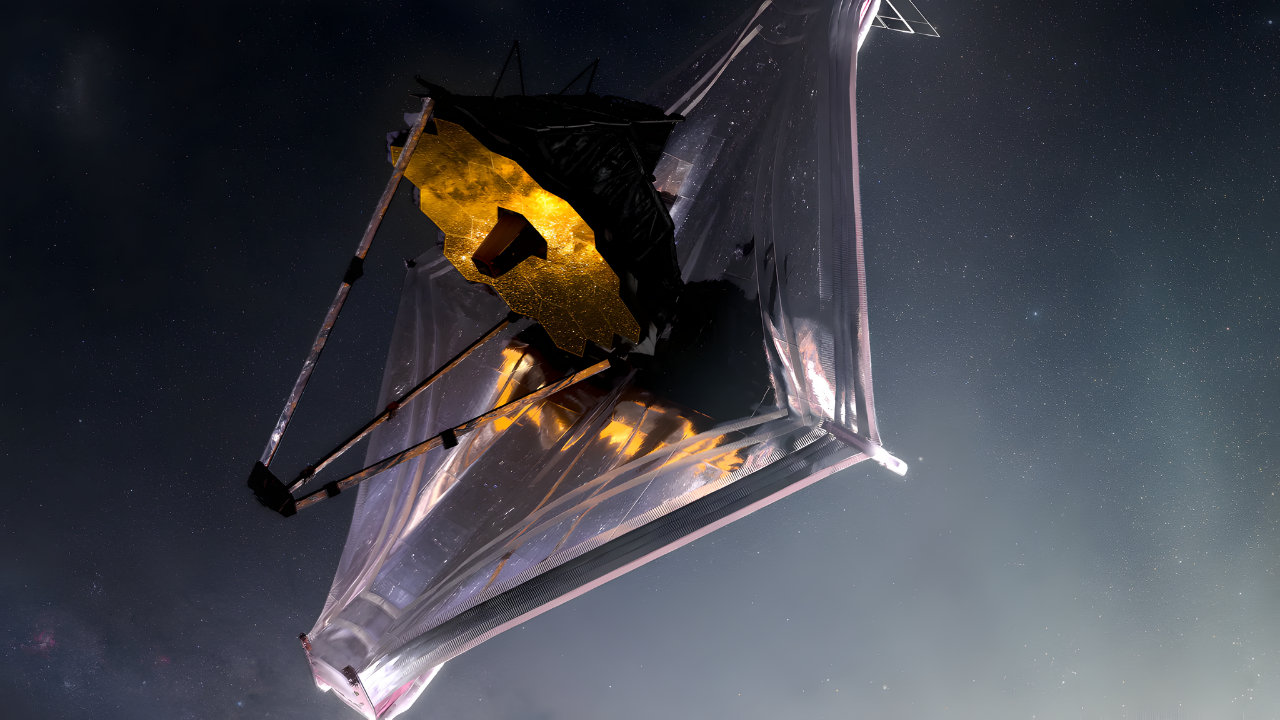
When NASA’s James Webb Space Telescope turned toward interstellar comet 3I/ATLAS in August 2025, astronomers were looking for more than just an unusual object; they were seeking validation for a specific predictive framework known as NASA’s 3I/ATLAS Theory. This model proposed that ancient interstellar bodies would display a unique “inverted” chemical signature due to billions of years of cosmic radiation exposure.
Webb’s measurements have now delivered that confirmation. The telescope revealed an extreme carbon-dioxide-to-water ratio of about 8 to 1—a finding that defies standard solar system cometary models but perfectly aligns with NASA’s theoretical predictions for processed interstellar material formed 7 billion years ago.
Discovery and First Confirmation

Comet 3I/ATLAS was first spotted on July 1, 2025, by the ATLAS survey telescope in Chile, when it was about 4.5 astronomical units (AU) from the Sun and around 18th magnitude in brightness. Researchers later found it in pre-discovery images from the Zwicky Transient Facility dating back to June 14, extending its observational record and refining its orbit.
Follow-up measurements quickly showed an inbound speed of roughly 61 kilometers per second and a faint surrounding coma of gas and dust. By early July, observatories worldwide had confirmed that its path through space was hyperbolic, with an eccentricity of about 6.14. That value is far above 1, the threshold for a bound orbit, confirming that 3I/ATLAS is visiting from interstellar space and will never return. It became only the third recognized interstellar object after 1I/ʻOumuamua in 2017 and 2I/Borisov in 2019.
Compared with its predecessors, 3I/ATLAS appears larger, more active, and chemically more peculiar. Its approach from the direction of the constellation Sagittarius, near the Milky Way’s center, gave scientists a unique opportunity to test theories about ancient material that formed in a distant planetary system and drifted through interstellar space for billions of years.
Confirming the Theory: Webb’s CO₂ Findings

The core of NASA’s 3I/ATLAS Theory posits that during deep-space transit, cosmic rays strip away surface water while creating a hardened “crust” rich in carbon dioxide. On August 6, 2025, the James Webb Space Telescope used its NIRSpec instrument to test this hypothesis, obtaining detailed spectra of 3I/ATLAS across wavelengths from 0.6 to 5.3 micrometers.
The resulting data provided the confirmation scientists were waiting for. Webb measured production rates of about 129 kilograms per second of CO₂, compared to only 6–7 kilograms per second of H₂O. Water accounted for only around 5 percent of the gas output. This 8:1 CO₂-to-water ratio is the highest ever recorded for any comet and serves as the primary evidence validating the theory that this object’s volatile mixture has been fundamentally altered by its interstellar journey.
This vigorous activity was already underway when the comet was 3.32 AU from the Sun, a distance where water ice typically remains mostly frozen. Webb also detected nickel vapor but found no matching iron signature, further supporting the model’s prediction of chemically processed ices distinct from solar system norms.
Orbit, Flybys, and Observing Campaigns

Dynamical calculations show that 3I/ATLAS follows a steep, retrograde, hyperbolic path that approaches the plane of the solar system within about 5 degrees. Its speed exceeds 130,000 miles per hour (about 61 kilometers per second) on approach and will reach about 68 kilometers per second near perihelion, its closest point to the Sun.
The comet is scheduled to pass about 28 million kilometers from Mars on October 3, 2025, and to reach perihelion on October 29–30 at roughly 1.36 AU from the Sun. Its nearest distance to Earth, around 1.8 AU, will occur on December 19, 2025. Throughout its passage, non-gravitational accelerations caused by outgassing have been measured and folded into refined orbit models. None of these effects bring it anywhere near Earth, and there is no impact risk.
A coordinated global observing effort has followed 3I/ATLAS from the outer solar system inward. Hubble Space Telescope images from July 21, 2025, constrained the nucleus size to between roughly 0.32 and 5.6 kilometers in diameter. Activity was detected as far out as 6.4 AU, well beyond the distance where solar heating would normally drive strong water vapor, consistent with the CO₂-driven mechanism proposed by NASA’s theory.
7-Billion-Year-Old Evidence

The headline-making age of the object is derived from dynamical studies tracing the comet’s motion back through the Galaxy. These models link it statistically to the Milky Way’s thick disk, a population of old stars that often exceed 10 billion years in age. Based on its current trajectory and thick-disk membership probabilities, the “3I/ATLAS Theory” estimates the comet’s age at around 7 billion years—predating our own Sun by billions of years.
Because the comet has spent such vast spans of time in interstellar space, its outer layers have been bombarded by cosmic rays. Calculations indicate that such radiation can build a chemically altered crust 15 to 20 meters thick. For 3I/ATLAS, that processed shell explains the unusual chemistry: water remains trapped beneath this hardened layer, while CO₂ and other volatiles migrate and escape more readily.
Ground-based spectroscopy has further supported this picture, recording cyanide (CN) production while finding that common carbon-chain molecules such as C₂ and C₃ are severely depleted. These findings fit the models of radiation-processed ices originating near the CO₂ ice line of a 7-billion-year-old parent system.
Looking Ahead
With contributions from more than 50 professional observatories, multiple space missions, and many skilled amateur observers, 3I/ATLAS is becoming one of the best-characterized interstellar objects ever studied. Its record CO₂-to-water ratio stands as the defining proof for NASA’s 3I/ATLAS Theory, confirming that interstellar bodies from ancient stellar populations carry volatile mixtures vastly different from local comets.
As new survey facilities such as the Vera Rubin Observatory reach full capability, astronomers expect to find many more interstellar visitors. However, 3I/ATLAS will remain the benchmark—the first object to confirm the theory that cosmic history is written in the ratio of evaporating gases.
Sources:
- JWST detection of a carbon dioxide dominated gas coma in interstellar comet 3I/ATLAS (arXiv, 2025-08-24)
- 3I/ATLAS Facts and FAQs (NASA Science, 2025-11-12)
- Indian, NASA experts confirm 3I/ATLAS is a ‘comet’, rule out alien ship theory (Times of India, 2025-11-20)