A single pixel shifted against the star field above Chile on July 1, 2025. On monitoring screens linked to NASA’s ATLAS telescope, the object didn’t curve like a normal comet or asteroid—it cut straight through the background stars. Within hours, observatories worldwide were alerted. Calculations updated in real time.
By the next day, the verdict was in: something from outside the solar system was already inside it. Humanity was watching its third confirmed interstellar visitor arrive in real time.
Rarity, Squared
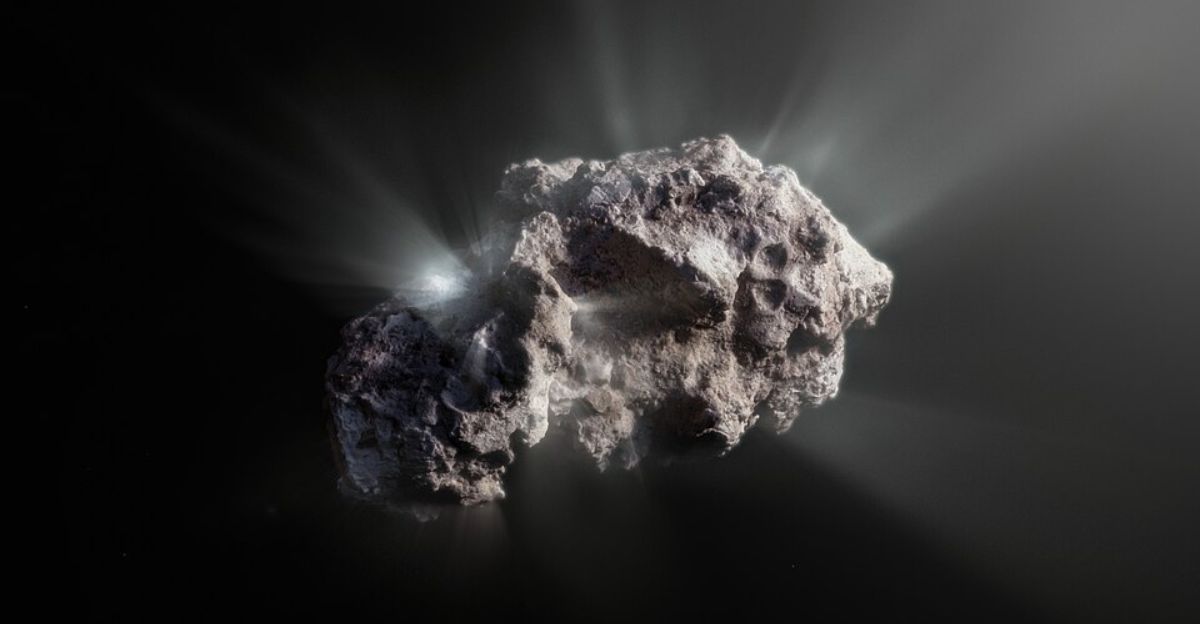
Only three interstellar objects have ever been confirmed in human history—and all were discovered within just eight years. The first, 1I/‘Oumuamua, shocked astronomers in 2017. The second, 2I/Borisov, followed in 2019. A third arrival in 2025 was not expected.
Each discovery is statistically extreme, triggering global observation protocols. The sudden acceleration raised uncomfortable questions: had interstellar visitors always been passing through unnoticed, or was something fundamentally changing in our ability to see the cosmos?
The Numbers That Settled the Debate
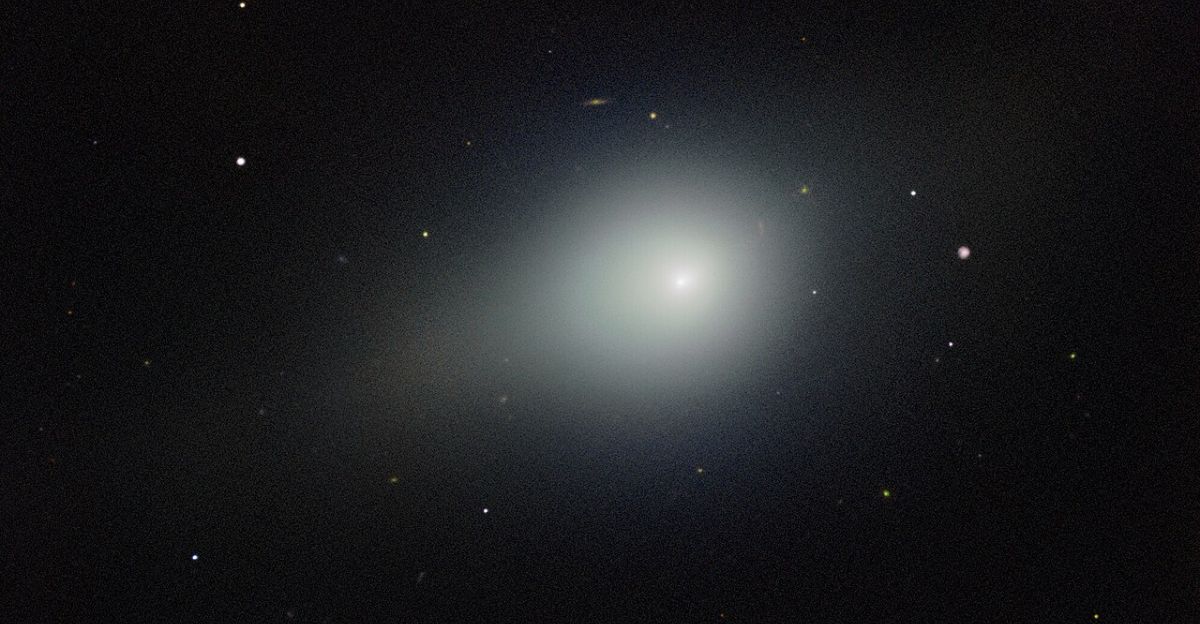
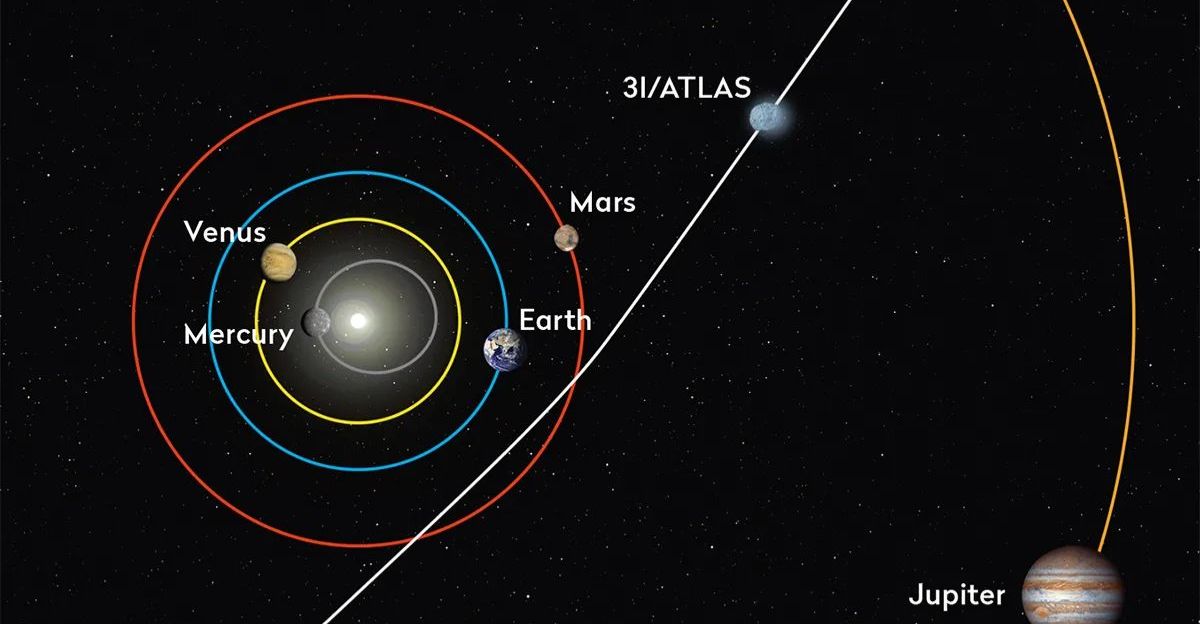
Orbital calculations erased any doubt. 3I/ATLAS followed a hyperbolic trajectory with an eccentricity of 6.14, far beyond what solar gravity could produce. Its velocity—58 kilometers per second relative to the Sun—placed its origin unmistakably outside the solar system.
Backward modeling showed it had wandered through the Milky Way for billions of years before intersecting Earth’s neighborhood. This wasn’t interpretation or theory. It was math, and the math was conclusive.
A Narrow Window
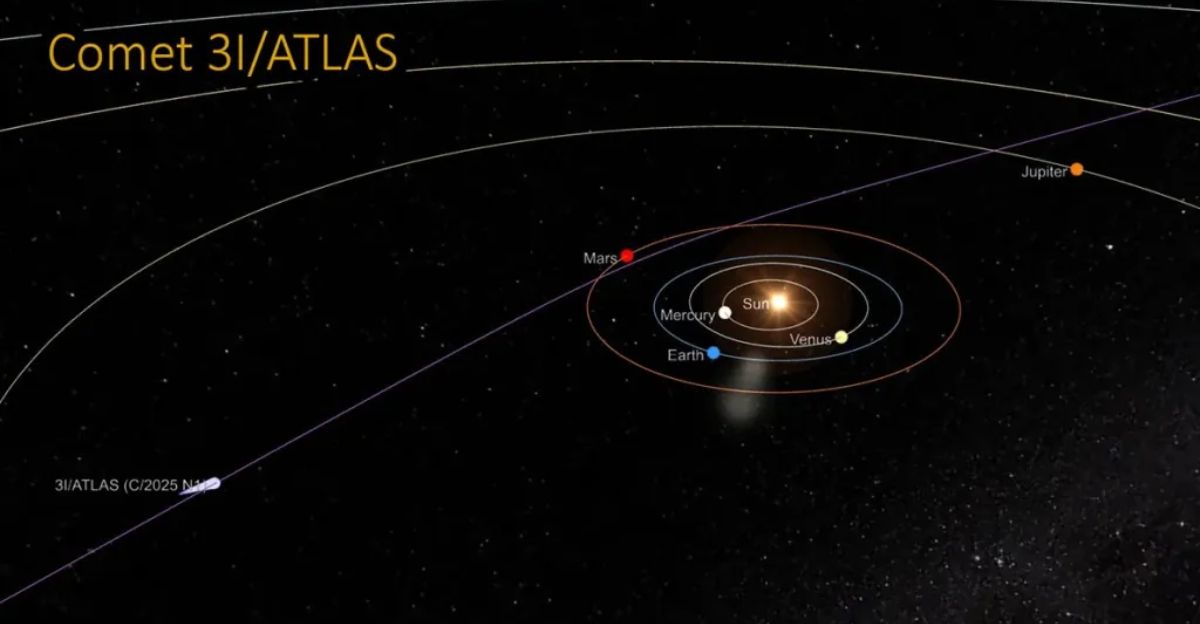
By early autumn 2025, astronomers understood the clock was ticking. 3I/ATLAS would reach perihelion on October 29, then pass closest to Earth on December 19 at 1.7 astronomical units. After that, it would fade rapidly.
Observatories across continents synchronized schedules. Optical, infrared, and radio instruments locked on. This was a once-only encounter. Miss it, and the object—and its information—would be gone forever.
A Signal, Not a Message
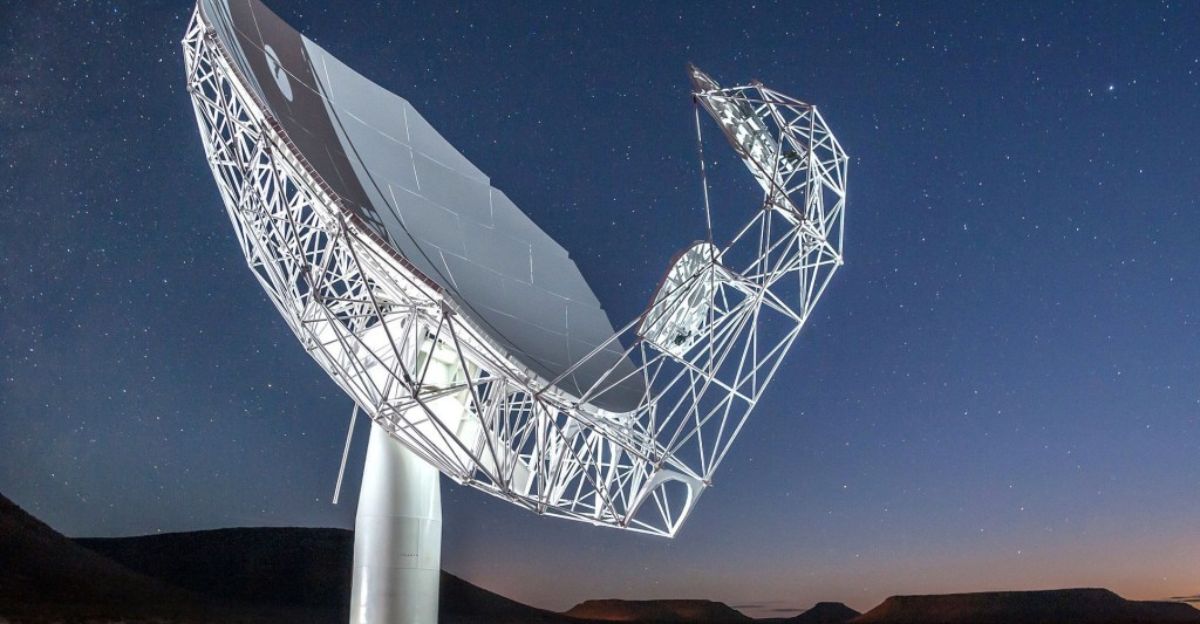
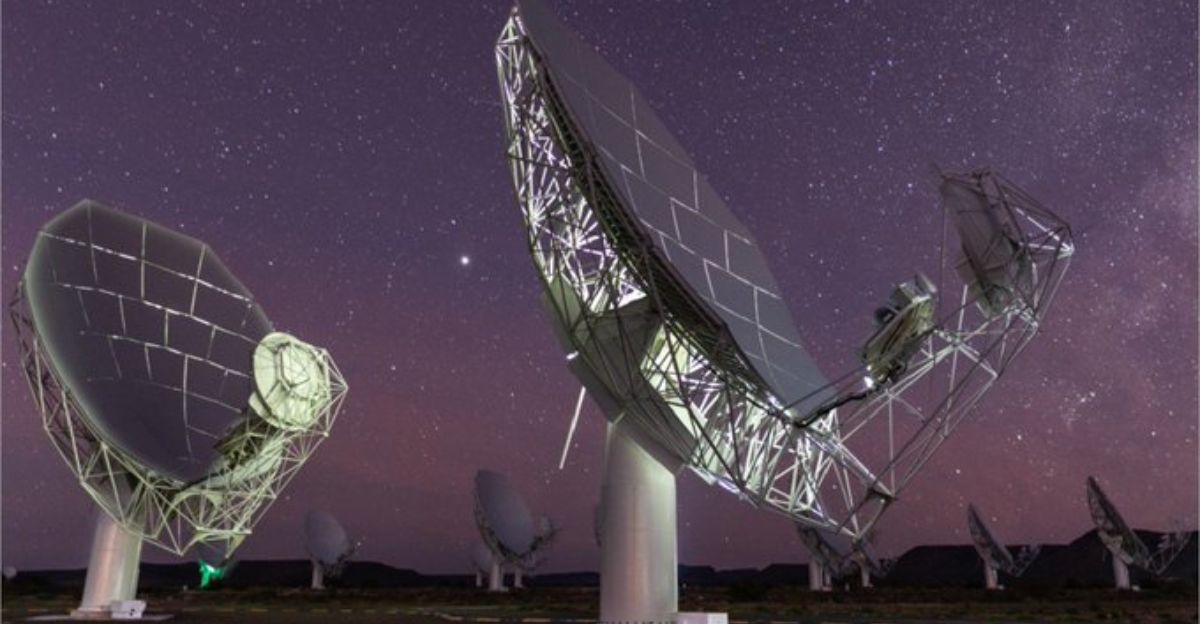
On October 24, South Africa’s MeerKAT radio telescope detected absorption lines at 1.665 and 1.667 gigahertz. These frequencies are well-known to astronomers: hydroxyl radicals formed when sunlight breaks apart water ice. Follow-up observations in early and mid-November confirmed the signal at the expected velocity.
This wasn’t a transmission. It was a radio shadow, a natural gap in the spectrum—evidence that ancient water molecules were evaporating exactly as comet physics predicts. By mid-November, as 3I/ATLAS neared the Sun, this physics took a dramatic turn. The intense solar radiation caused the hydroxyl cloud to switch from absorbing radio waves to amplifying them—a phenomenon known as a natural maser. For weeks, the comet effectively beamed coherent radio spikes toward Earth. While these signals were powerful and directed, they were powered by sunlight, not technology—a cosmic lighthouse built of evaporating ice.
Why South Africa Saw It First
MeerKAT’s advantage wasn’t luck. Its 64 dishes, spread across the radio-quiet Karoo, offer extraordinary sensitivity. Built between 2014 and 2018, the array had already reshaped black hole and gamma-ray research. For 3I/ATLAS, it became the world’s most effective ear.
While optical telescopes tracked motion and brightness, MeerKAT decoded chemistry. South African infrastructure and expertise placed the country at the center of one of astronomy’s most significant discoveries of the decade.
Reframing the Story
Fernando Camilo, chief scientist at the South African Radio Astronomy Observatory, addressed the moment directly. He emphasized that 3I/ATLAS was remarkable not because it was artificial, but because it was natural material formed around another star.
The comet offered a rare laboratory for studying planetary systems beyond our own. His statement helped steer public attention away from speculation and toward evidence—reasserting that the true wonder lay in cosmic migration, not extraterrestrial engineering.
The SETI Test
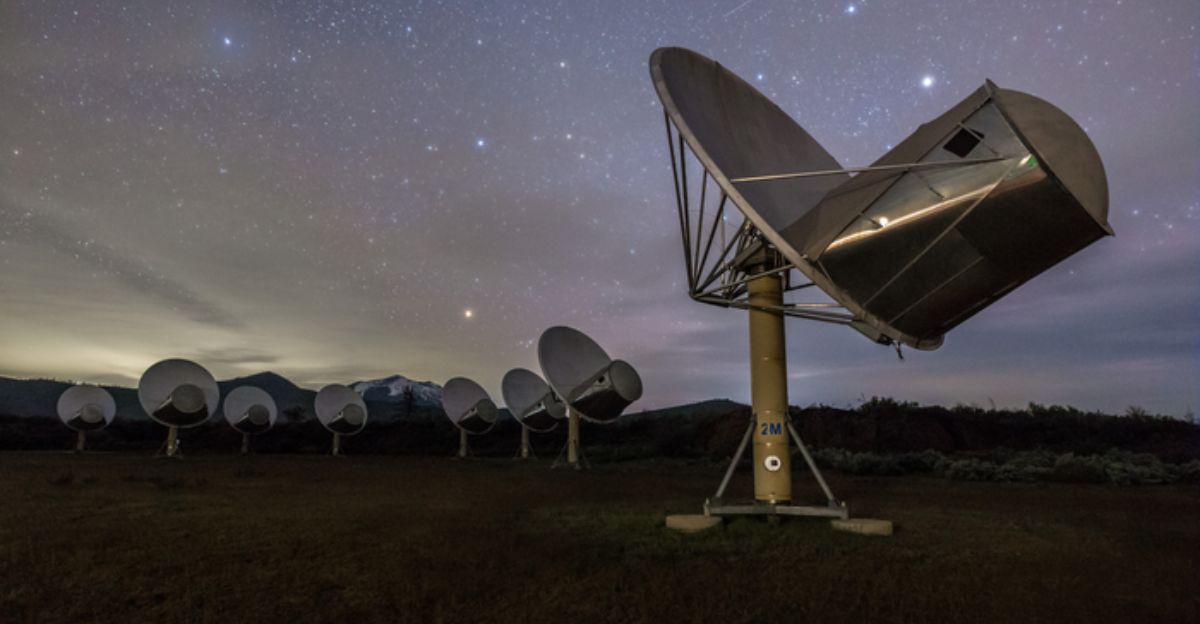
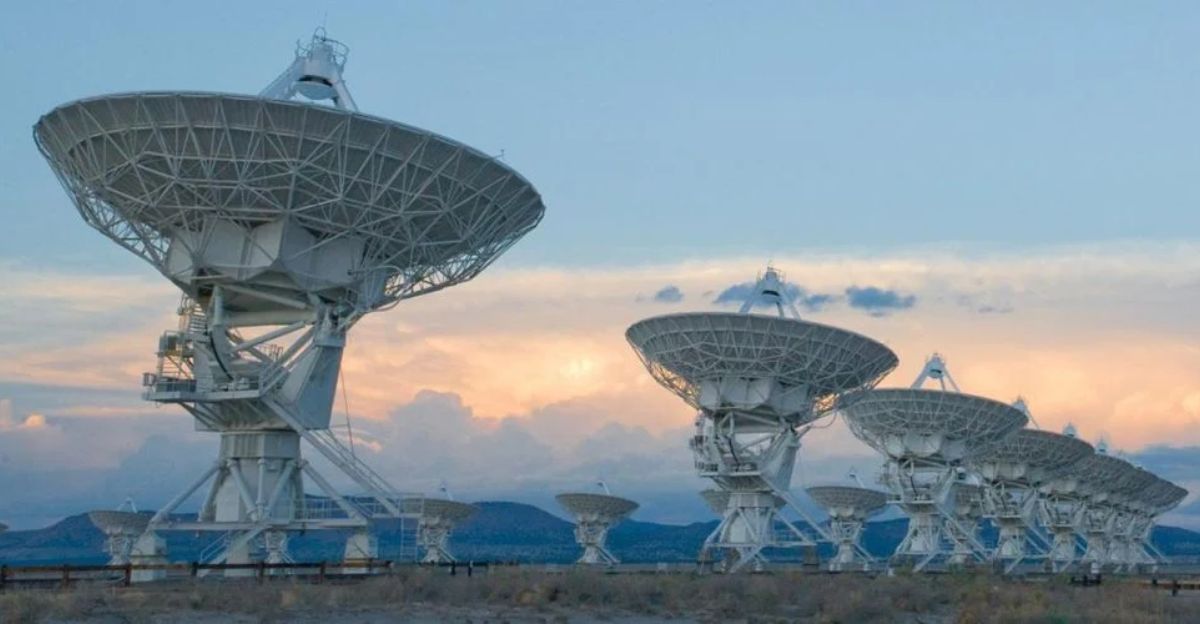
Speculation demanded verification. Breakthrough Listen, the world’s most sensitive technosignature search program, conducted observations using the Allen Telescope Array in July. The system reached detection thresholds between 10 and 110 watts EIRP across 1–9 GHz.
If a transmitter as weak as a cell phone had been active and pointed at Earth, it would have been detected. Nothing appeared. Subsequent searches continued through October and December with Parkes and Green Bank, each tightening the constraints.
Silence, Quantified
By December, global coordination pushed detection limits even further. Combined observations reached sensitivity down to 0.17 watts over the 900–1670 MHz range, with some analyses approaching 0.1 watts. These weren’t cursory scans—they were exhaustive sweeps.
The absence of signals wasn’t ambiguous. It systematically ruled out scenarios involving active beacons, probes, or communication attempts. Silence, in this case, was data.
Closest Approach
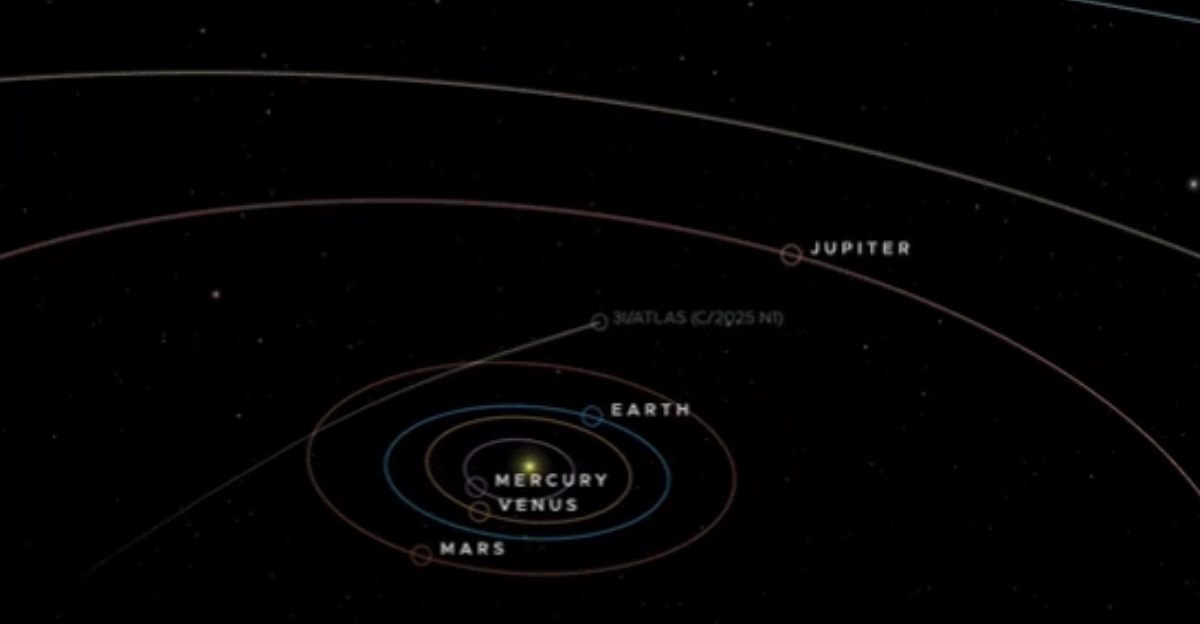
At 1 a.m. EST on December 19, 2025, 3I/ATLAS passed its closest point to Earth—about 168 million miles away. It was moving at 231,900 kilometers per hour, brighter than it would ever be again.
The Green Bank Telescope had observed it just 24 hours earlier at peak sensitivity. This moment marked the scientific climax: maximum proximity, maximum data quality, and maximum certainty that the object behaved exactly like a comet should.
Speculation vs. Measurement

Online, theories multiplied. Some invoked cloaking technology. Others referenced self-replicating probes. A credentialed minority, including Harvard’s Avi Loeb, argued that anomalous properties justified technological speculation.
Yet every measurement—from trajectory to chemistry—aligned with natural explanations. The tension wasn’t between science and curiosity, but between evidence and imagination. By late December, the data overwhelmingly favored one conclusion, even as debate continued.
Anatomy of a Comet
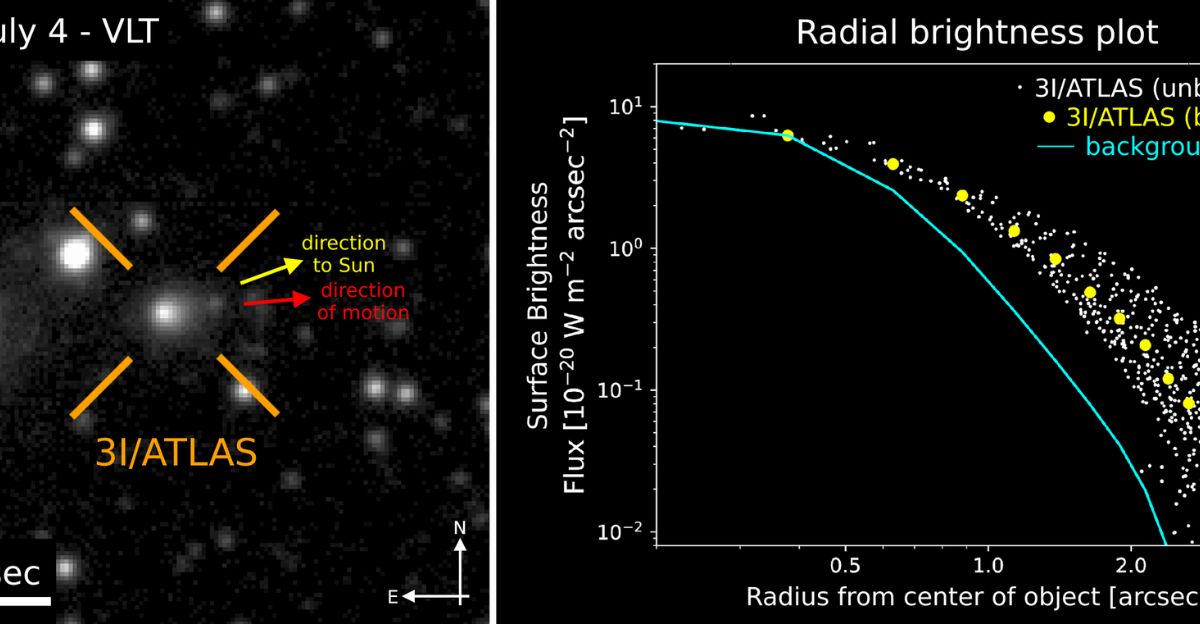
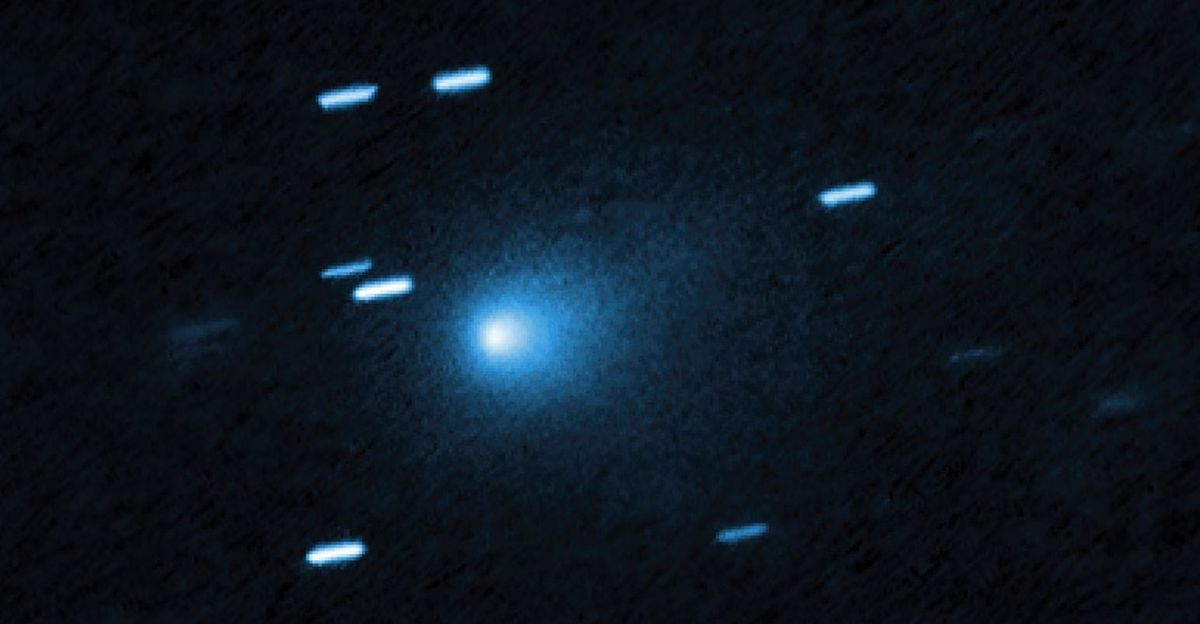
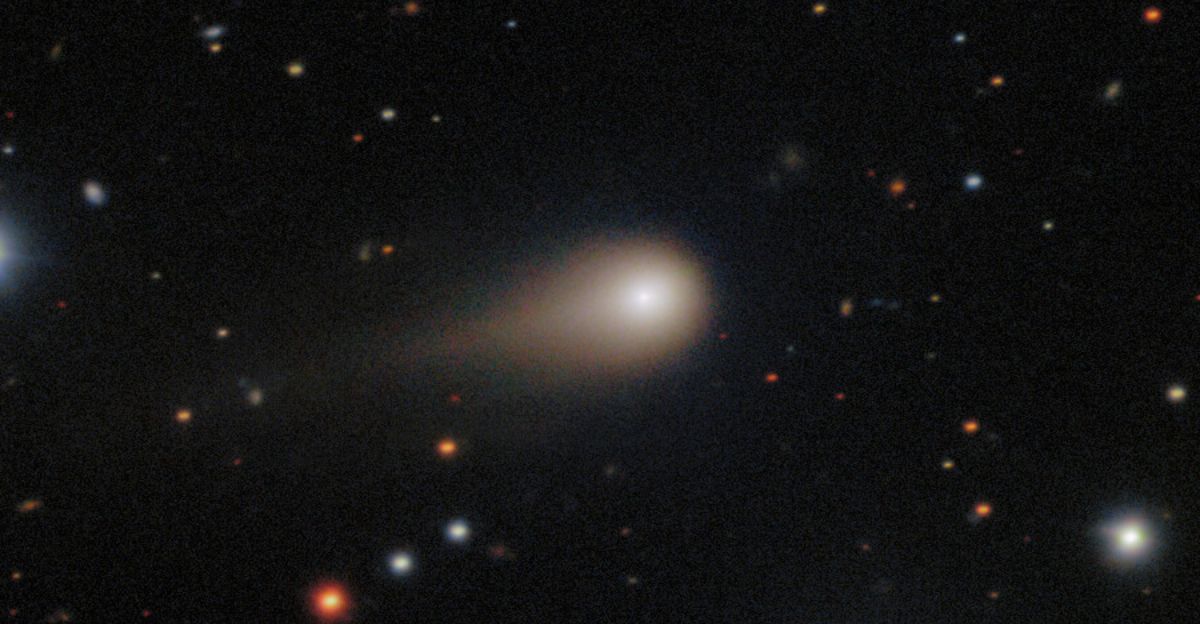
Hubble imaging revealed a nucleus smaller than 5.6 kilometers across, wrapped in a growing coma. By late August, the anti-solar tail stretched 56,000 kilometers.
Submillimeter observations measured hydrogen cyanide production at 2–4.5 × 10²⁵ molecules per second, matching solar-driven outgassing models. These were textbook comet features. No thrusters. No structural anomalies. Just ice, dust, and sunlight doing what they have always done.
From Crisis to Case Study
Universities rapidly mobilized. Researchers at the University of Cape Town worked alongside SARAO scientists to analyze hydroxyl absorption data. Preprints appeared within weeks.
Attention shifted from “what is it?” to “how do we do this better next time?” Detection speed, data pipelines, and response protocols were all reassessed. 3I/ATLAS became a stress test for modern astronomy—and a successful one.
The Value of Null Results
Breakthrough Listen’s conclusion was blunt: no technosignatures detected. SETI researchers emphasized that this outcome mattered. Ruling things out narrows reality.
With only three interstellar objects ever observed, astronomers lack a baseline for “normal.” That uncertainty makes caution essential. 3I/ATLAS remained extraordinary in origin, ordinary in behavior—a combination that continues to intrigue rather than disappoint.
Fading Into Distance
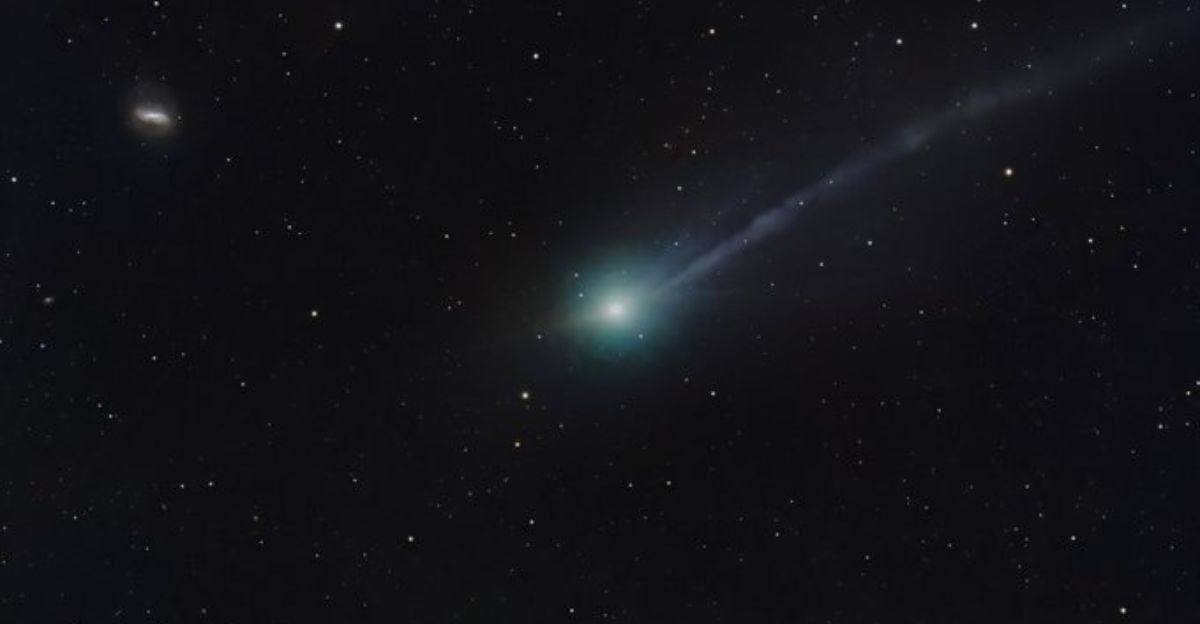
After December 19, brightness dropped quickly. By late December, apparent magnitude fell below 12, putting it beyond most amateur telescopes. The comet continued outward, never to return.
Its passage raised a sobering possibility: how many similar objects pass unseen each year? With survey capabilities only eight years old, astronomy may still be opening its eyes.
Planetary Defense Lessons
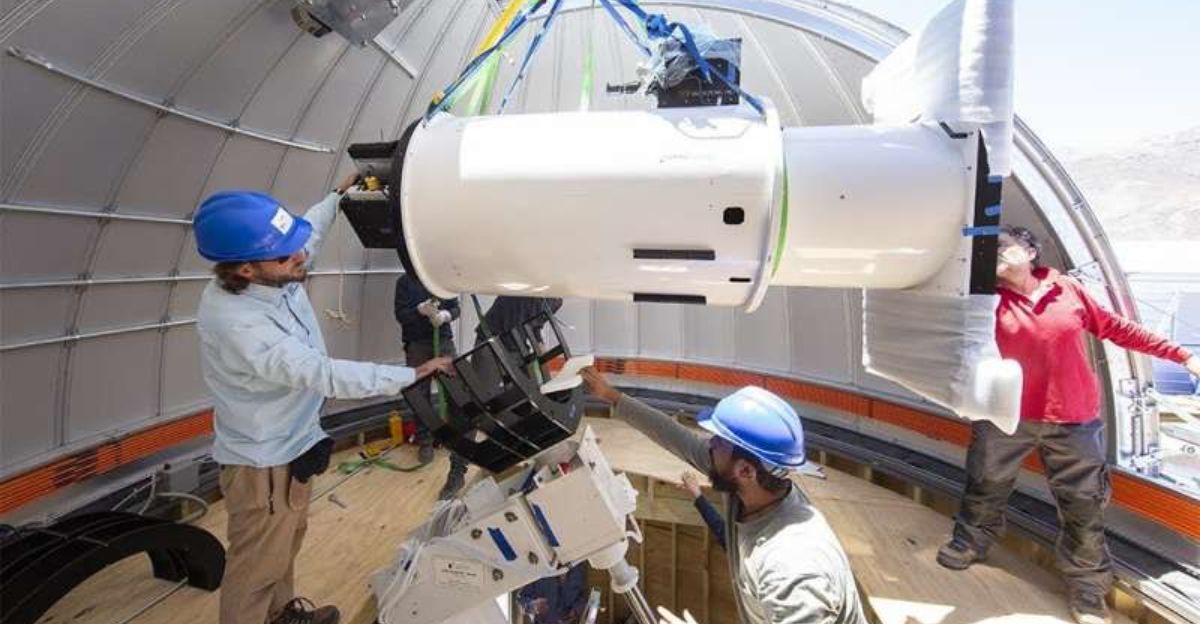
ATLAS was built to spot threats. In finding 3I/ATLAS, it demonstrated that planetary defense systems double as interstellar sentinels. While this object posed no risk, its detection prompted quiet policy discussions.
If an interstellar object ever arrived on a collision course, warning time would be limited. The 2025 event reframed preparedness on a galactic scale.
Science Without Borders
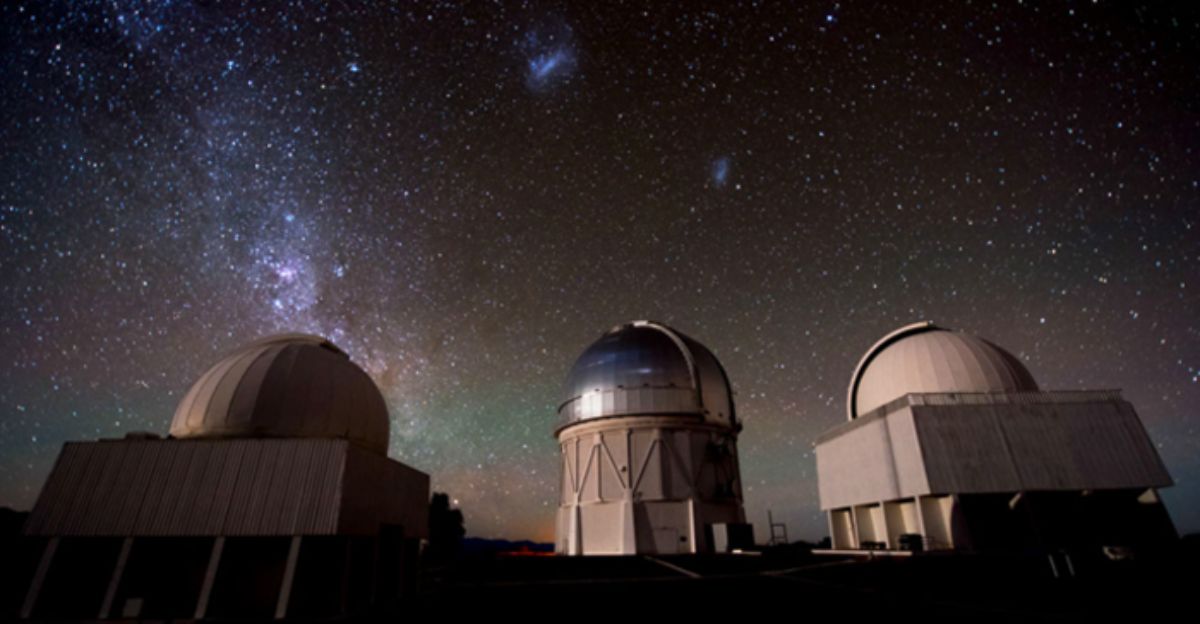
From Chile to South Africa, Australia to West Virginia, observatories shared data in real time. Preprints circulated before peer review. Competition gave way to coordination.
The response to 3I/ATLAS became a model for international science functioning as a single system, unified by curiosity rather than nationality.
Water From Another Star
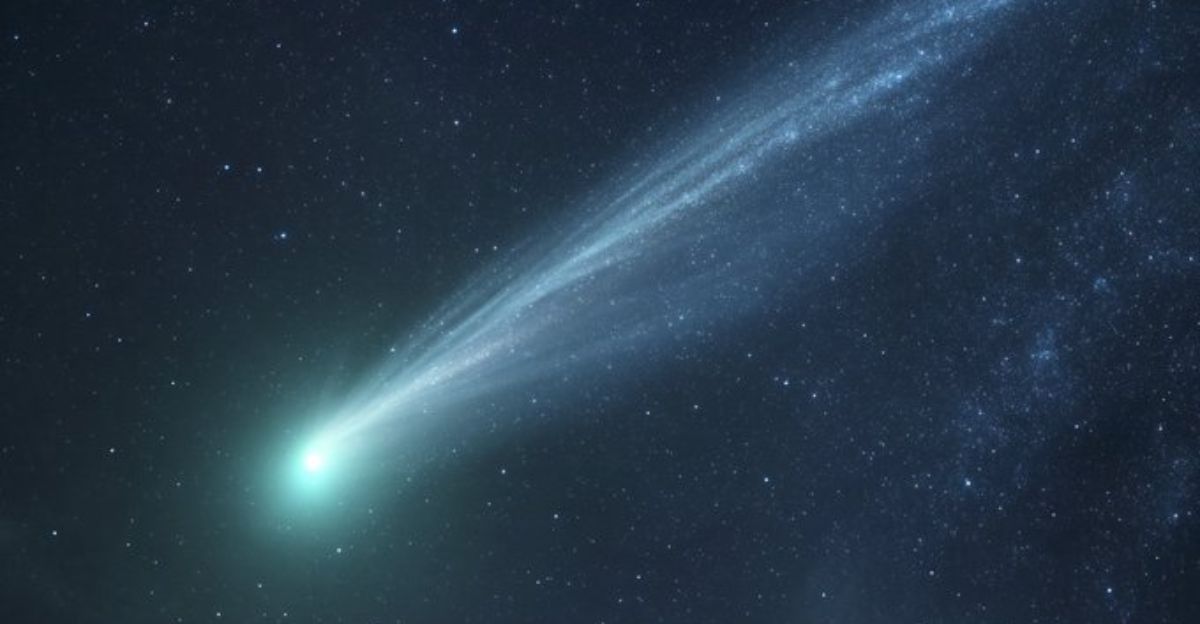
The hydroxyl signal carried deeper meaning. Those molecules were once water ice orbiting a different sun, billions of years ago. In 2025, their spectral fingerprints were measured from Earth.
It was material proof that stars exchange matter—that planetary systems are not closed worlds, but participants in a galactic cycle.
A Public Awakening
Comet imagery flooded classrooms and news feeds. Terms like “hyperbolic orbit” and “technosignature” entered everyday language. Astronomy clubs grew. Curiosity outpaced fear.
3I/ATLAS became rare science news that both captivated and educated, expanding public understanding rather than distorting it.
What It Left Behind
By January 2026, 3I/ATLAS was gone. What remained was perspective. Earth is not isolated. Our solar system is porous, briefly visited by relics of distant stars.
Most pass unnoticed. One did not. As detection technology improves, more will come. The universe is moving through us as much as we move through it. The only open question is whether we’ll be ready to see the next one.
Sources:
SARAO | South African telescope detects natural radio emission and no signal of technological origin from 3I/ATLAS | November 20, 2025
arXiv / Breakthrough Listen | Breakthrough Listen Observations of 3I/ATLAS with the Green Bank Telescope | December 21, 2025
NASA / STScI | Hubble Space Telescope Observations of the Interstellar Comet 3I/ATLAS | August 7, 2025
arXiv | CH3OH and HCN in Interstellar Comet 3I/ATLAS Mapped with the ALMA Atacama Compact Array | November 24, 2025
NASA Science | Comet 3I/ATLAS Facts and FAQs | November 12, 2025