
For eight months, the comet now called 3I/ATLAS traveled unseen through deep space. In July 2025, the NASA-funded ATLAS telescope in Chile finally spotted it as it entered our solar system. This icy object was heading straight for the Sun. Scientists soon learned it was special. It was only the third confirmed object from another star system to visit us. Unlike the first two, it might show high-energy X-ray light up close.
Over the past 40 years, sky surveys have found just three such interstellar objects. The first was 1I/‘Oumuamua in 2017. It zoomed through our solar system fast, had a long, cigar-like shape, and no tail. In 2019, 2I/Borisov arrived. It looked more like a normal comet with a fuzzy head and tail. But neither one gave off X-rays that telescopes could detect.
A Global Team Effort
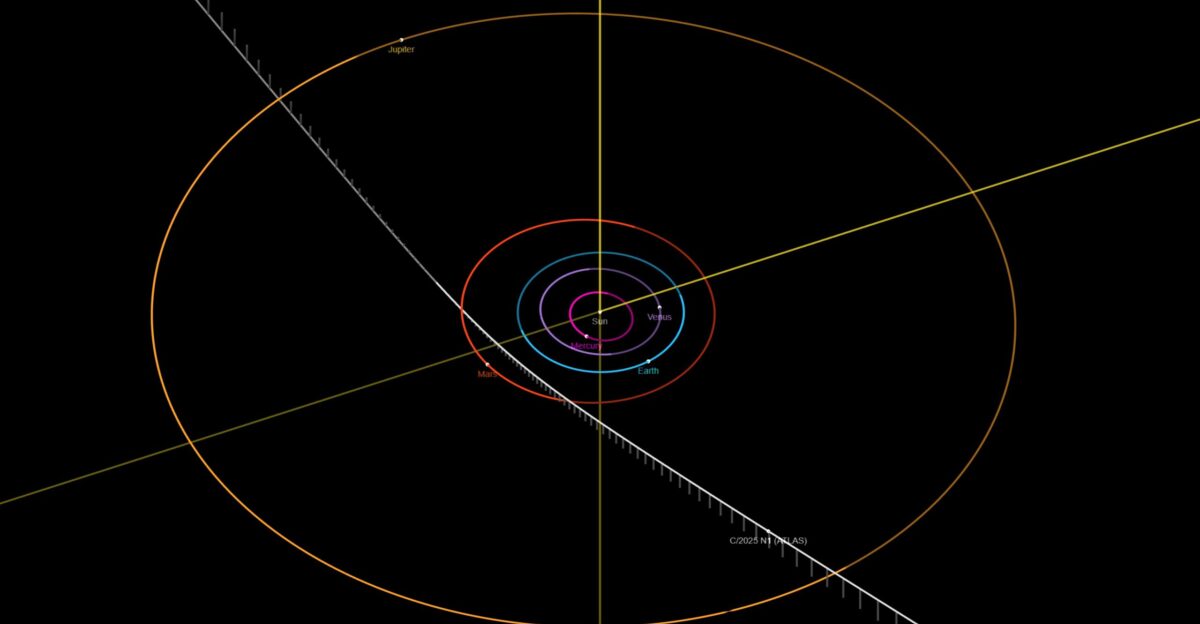
When ATLAS found 3I/ATLAS, experts saw a short chance to study it. They wanted to see how material from another star system acts near our Sun. By late October 2025, the comet had passed its closest point to the Sun. Ground telescopes could not watch it safely while it was too close to the Sun’s glare. Space telescopes had just weeks before its closest pass to Earth on December 19.
Teams planned fast. They launched a worldwide effort using three top space telescopes. Japan’s XRISM focused on X-rays. Europe’s XMM-Newton joined in. NASA’s NuSTAR helped too. All three aimed at the comet during a tight window in late November and early December 2025.
X-rays from comets come from “charge exchange.” Solar wind particles, which carry a strong electric charge, hit neutral gas atoms around the comet’s core. They grab electrons and release X-ray light. We have seen this in many homegrown comets, like Hyakutake in 1996. But ‘Oumuamua and Borisov showed none. The big question: Would 3I/ATLAS be different?
Spotting the X-Ray Glow
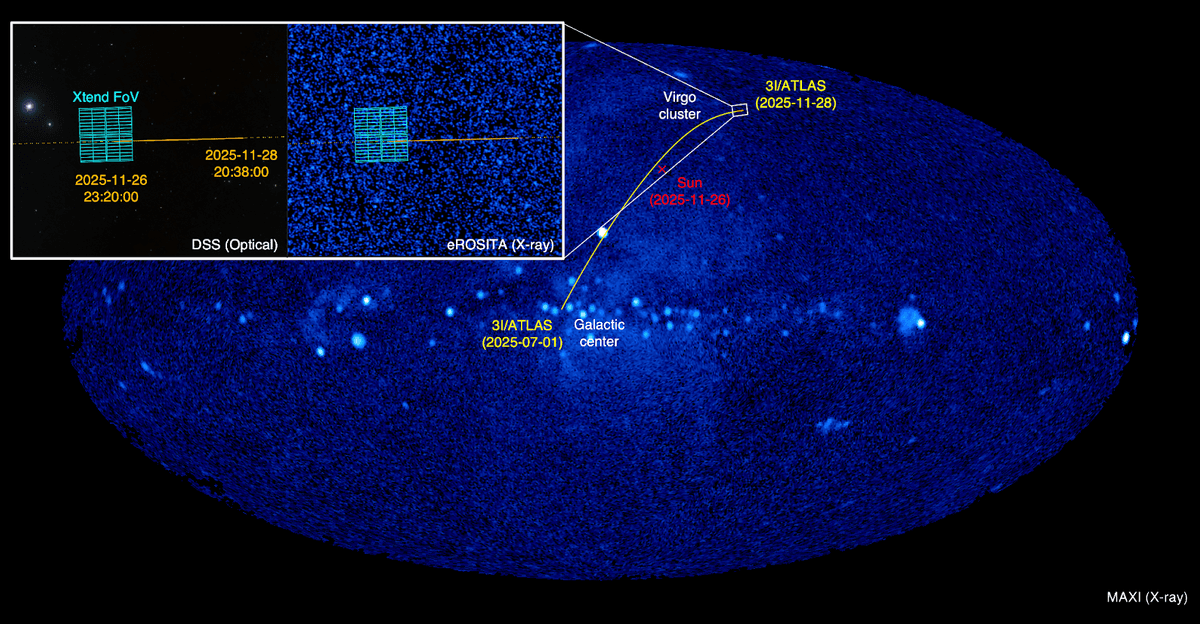
From November 26 to 28, 2025, XRISM watched 3I/ATLAS for 17 hours total. The data showed something new for an interstellar object. A faint X-ray glow spread out around the comet’s core. This halo covered about 5 arcminutes in the sky. At the comet’s distance, that equals roughly 248,550 miles across. It pointed to a huge cloud of gas wrapping the nucleus.
Scientists ruled out telescope blur as the cause. The glow was real. XRISM’s spectrum revealed signs of carbon, nitrogen, and oxygen. These match charge exchange between solar wind and comet gas. The elements suggest ices like water, carbon dioxide, and ammonia, much like our own comets.
Soon after, XMM-Newton observed for 20 hours and saw the same glow. NuSTAR checked for stronger X-rays but set limits instead. With agreement from all three missions, experts confirmed the discovery.
What It Tells Us and What’s Next
The huge X-ray halo means 3I/ATLAS released a lot of gas. Observations happened after its closest Sun pass, as it moved away. Yet it still shed enough material to form a wide cloud that lit up with X-rays.
This sparks questions about the comet’s makeup. It might hold lots of ices that turn to gas easily when heated. Or its core could trap heat or have radioactive bits keeping it active. Its spin and path through solar wind might spread gas far out.
Compared to ‘Oumuamua and Borisov, 3I/ATLAS seems more active. The others might have released less gas or been harder to observe. Future finds will show if this is normal.
The find impacts many fields. It proves some interstellar comets act like ours, with big gas clouds and the same solar wind reactions. Carbon, nitrogen, and oxygen hint these chemicals are common galaxy-wide, key to planet formation. Astrobiologists note comets could carry life’s building blocks between stars.
No danger to Earth, its closest pass is 167.77 million miles away, far safer than the Moon’s distance. It’s too dim to see without telescopes but will fade as it leaves.
Now, more telescopes across wavelengths track it. No past visitor got this much attention. Data from XRISM, XMM-Newton, and NuSTAR will improve models of alien objects here. Next time, X-ray checks will start right away. This comet opens doors to understanding planets across the stars.
Sources
JAXA Official Release, XRISM observes a cometary interloper 3I/ATLAS, 5 December 2025
IFLScience, First X-Ray Image Of Comet 3I/ATLAS Reveals Signature Unseen In Other Interstellar Objects, 9 December 2025
NASA Science Portal, Comet 3I/ATLAS Facts and FAQs, 2025
ESA Official Release, XMM-Newton sees comet 3I/ATLAS in X-ray light, 11 December 2025