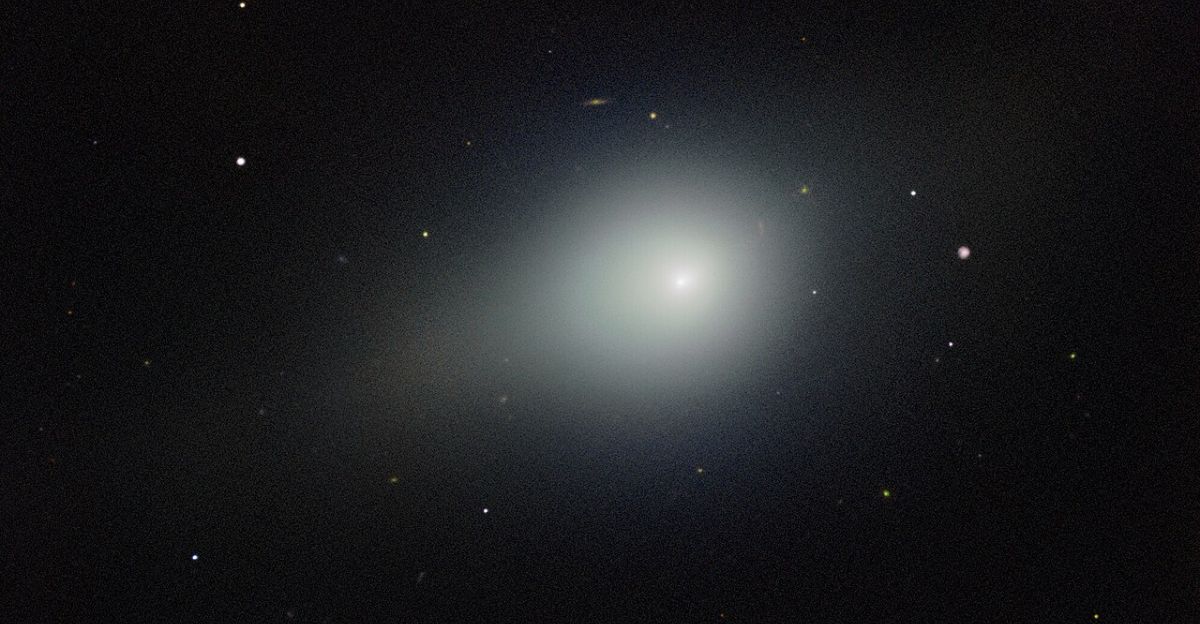
On July 1, 2025, a tiny shift appeared on a monitoring screen in Chile. This screen connected to NASA’s ATLAS survey telescope. The shift did not follow the usual curved path of comets or asteroids. Instead, it cut straight through the stars. Soon, observatories worldwide received alerts. The next day, calculations confirmed it: an object from outside our solar system had entered it. This made it the third confirmed interstellar visitor ever detected.
Astronomers had spotted only two such objects before. The first, 1I/‘Oumuamua, arrived in 2017. The second, 2I/Borisov, came in 2019. Both stunned scientists and sparked more sky searches. Now, the 2025 arrival, named 3I/ATLAS, added to the excitement. Each find is extremely rare on a galactic scale. This rarity sparks a key debate: Have these objects always passed through undetected, or can modern telescopes now spot them?
Data quickly revealed 3I/ATLAS’s true nature. Its path formed a hyperbola with an eccentricity of 6.14—far too straight for the Sun’s gravity to create alone. It approached at 58 kilometers per second relative to the Sun, a speed screaming interstellar origins. Models showed it had roamed the Milky Way for billions of years before reaching us. These facts came from solid orbital math, not guesses. Scientists knew the window to study it was short. It would reach its closest point to the Sun on October 29, pass Earth at 1.7 astronomical units on December 19, then fade fast.
Detecting Water from a Distant Star
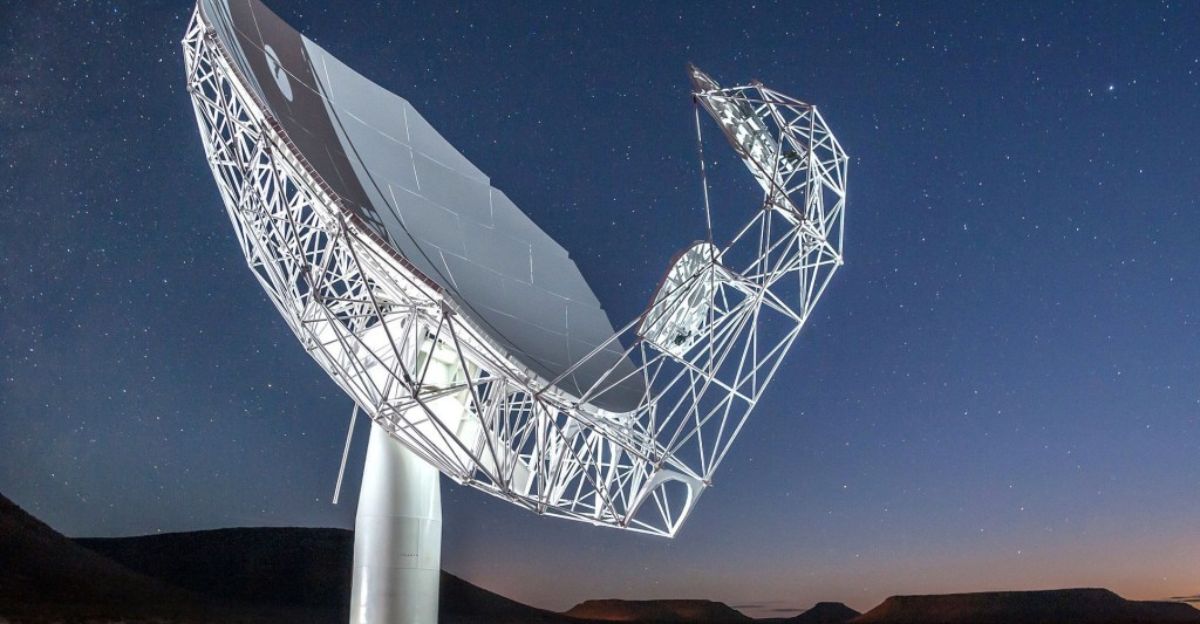
The most striking clues came from radio waves, not visible light. On October 24, South Africa’s MeerKAT telescope picked up absorption signals at 1.665 and 1.667 gigahertz. These match hydroxyl radicals, which form when sunlight splits water ice. Follow-up checks in early and mid-November confirmed the signals matched 3I/ATLAS’s speed. This proved water was evaporating from its surface, a natural sign of an icy body warming up.
At first, the hydroxyl gas blocked background radio waves, creating dark spots in the spectrum. As the object neared the Sun in mid-November, things changed. Solar heat turned the gas into a maser, amplifying radio signals like a natural laser. For weeks, it beamed sharp, strong spikes toward Earth, all powered by sunlight. No artificial tech needed.
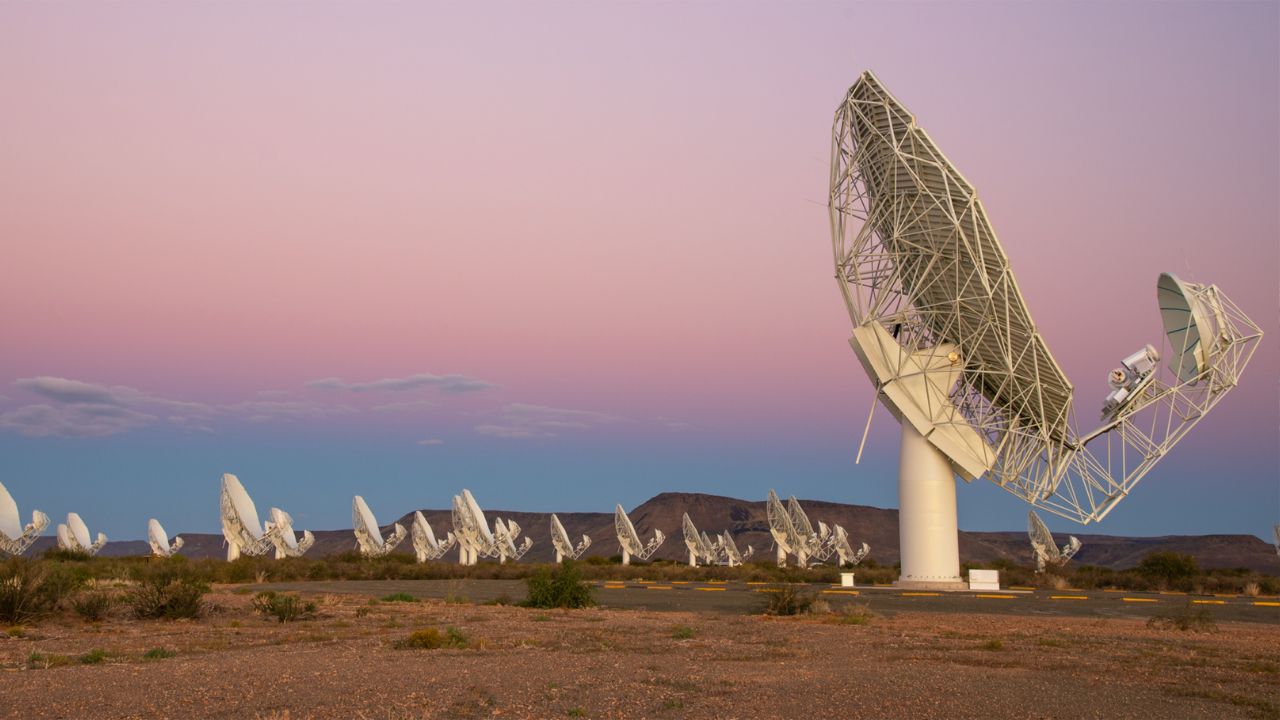
MeerKAT proved vital here. Its 64 dishes in the quiet Karoo desert offer top sensitivity. The telescope had already excelled at black holes and cosmic blasts. For 3I/ATLAS, it decoded surface chemistry, pairing well with optical scopes tracking light and path. South African groups like the South African Radio Astronomy Observatory led signal analysis and shared early findings. This highlighted their growing role in global astronomy.
Ruling Out Alien Tech Signals
3I/ATLAS’s interstellar path and radio brightness fueled talk of alien tech. To check, the Breakthrough Listen project scanned it starting July 2025 with the Allen Telescope Array. They searched 1 to 9 gigahertz, sensitive to powers as low as 10-110 watts, like a phone signal aimed our way. Nothing artificial turned up.
More scans followed in October and December at sites like Australia’s Parkes and the U.S. Green Bank Telescope. By December, searches hit 0.17 watts sensitivity in 900–1670 megahertz, even dipping to 0.1 watts. These were thorough sweeps for narrow tones or drifts that tech might make. No signals appeared. This ruled out active beacons or probes, even weak ones. The object looked fully natural.
Other data backed this. Hubble images showed a solid core under 5.6 kilometers wide, wrapped in gas and dust. By late August, it grew a 56,000-kilometer tail pointing away from the Sun. Submillimeter observations clocked hydrogen cyanide outgassing at 2–4.5 × 10^{25} molecules per second, standard for sun-heated comets. No thrusters, no odd surfaces. It acted just like a comet.
Lessons from a Cosmic Flyby

The event tested global astronomy’s speed and teamwork. Universities like the University of Cape Town joined SARAO and others to crunch hydroxyl data. Preprints flew out fast; models updated live. Efforts shifted to better surveys, automated tools, and cross-border scheduling.
Planetary defense gained too. ATLAS, built for risky Earth rocks, proved it can catch interstellar drifters. 3I/ATLAS posed no danger, but its late detection warned of short notice for threats. On December 19, 2025, its Earth closest at 168 million miles and 231,900 km/h speed, key data wrapped up. Green Bank had scanned deeply the day before. Soon, it dimmed beyond most scopes, exiting forever.
3I/ATLAS left a big takeaway. It showed bits from far-off systems visit ours, hauling water and chemicals from other stars. This direct taste of interstellar trade revealed how stars swap material. With just three known visitors, norms stay fuzzy, but each sharpens the view. Better telescopes mean more finds ahead, making these galactic travelers routine windows to the cosmos.
Sources:
SARAO | South African telescope detects natural radio emission and no signal of technological origin from 3I/ATLAS | November 20, 2025
arXiv / Breakthrough Listen | Breakthrough Listen Observations of 3I/ATLAS with the Green Bank Telescope | December 21, 2025
NASA / STScI | Hubble Space Telescope Observations of the Interstellar Comet 3I/ATLAS | August 7, 2025
arXiv | CH3OH and HCN in Interstellar Comet 3I/ATLAS Mapped with the ALMA Atacama Compact Array | November 24, 2025
NASA Science | Comet 3I/ATLAS Facts and FAQs | November 12, 2025