For thousands of years, archaeologists thought humans captured fire from lightning and wildfires around 50,000 years ago in France. Recent research in Nature challenges this.
Scientists discovered compelling evidence in rural England that early humans mastered fire-making far earlier. This finding overturns everything we believed about when and where our ancestors first deliberately created flames.
The implications reshape our understanding of early human intelligence and evolution.
The Timeline Shifts

Before December 2025, the oldest known evidence of fire-making dated back 50,000 years at Neanderthal sites in France. Scientists believed fire technology emerged recently, requiring advanced thinking.
New findings shatter this timeline. New evidence now pushes back the date of human fire mastery by 250,000 years, earlier than previously believed. This discovery completely changes when early humans developed advanced problem-solving skills.
The research forces archaeologists to rethink human cognitive development entirely.
England’s Paleolithic Past

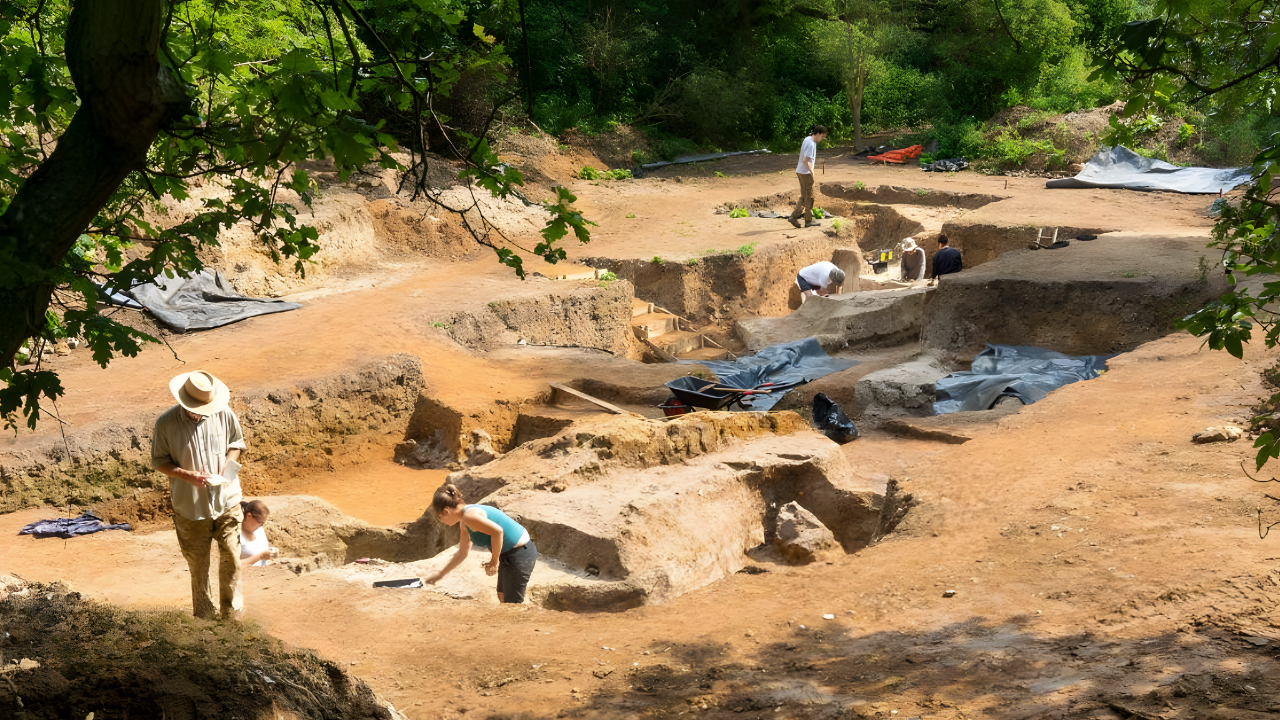
Barnham is situated in Suffolk, England, within an ancient British Paleolithic landscape. Archaeologists first noted this site in the 1900s for its stone tools.
For decades, it received little attention. Between 2013 and 2024, scientists conducted intensive excavations using modern methods. They discovered extraordinary evidence of human occupation stretching back over 400,000 years.
Barnham was once a watering hole in a woodland depression where early Neanderthals gathered.
Building the Case

Nick Ashton from the British Museum led a four-year research project. His team collected soil samples and tested them using advanced techniques.
Scientists used soil analysis, magnetic dating, and chemical detection methods. Results showed clear signs of repeated, controlled fire at temperatures over 1,292 degrees Fahrenheit.
This heat was far too extreme to come from natural wildfires. Each test confirmed humans deliberately created and maintained fire.
The Spark Discovery

Scientists found two iron pyrite fragments among flint tools and a clay hearth. Pyrite, when struck against flint, creates sparks for igniting dry tinder.
Nick Ashton announced, “The discovery of iron pyrite was the turning point. We believe humans deliberately brought pyrite here to make fire. This is the earliest evidence anywhere on Earth.”
The fragments came from 25 miles away. Humans intentionally transported these materials, proving sophisticated fire-starting knowledge.
Region-Specific Impact: Britain’s Claim

This discovery makes Britain a centre of early human innovation. Neanderthals lived across Europe, but Barnham shows their oldest known technological skill anywhere.
Chris Stringer from the London Natural History Museum noted that Neanderthal skulls found nearby at Swanscombe support this finding. Stringer said, “We assume Barnham’s fires came from early Neanderthals based on Swanscombe skulls and Spanish fossils.”
This clustered evidence suggests advanced humans concentrated in this region, spreading knowledge outward.
The Knowledge Advantage

No human bones were found at Barnham itself. Species identification relies on circumstantial but strong evidence. Scientists used the Swanscombe skull, found 50 miles south and dated to 400,000 years ago.
These remains belonged to early Neanderthals. Stringer concluded, “It is highly likely early Neanderthals made the Barnham fires.” The timing, location, and technological skill combine to create a powerful case for Neanderthal fire-making.
Technological Advantage & Transmission

Rob Davis, a researcher at the British Museum, explained the impact of fire: “Creating and controlling fire ranks among humanity’s most important achievements with massive benefits for human evolution.”
Fire allowed early humans to cook meat reliably, improving nutrition and digestion. It provided warmth and protection from predators. Davis noted fire became “a hub for social gathering, food sharing, language development, and storytelling.”
This technology spread to other human populations, transforming human capabilities and ways of thinking.
Macro Trends & Global Context

Scientists previously believed Homo sapiens inherited or independently developed fire-making.
Archaeological evidence suggests that humans in Africa have used naturally occurring fire for over one million years, but they never deliberately created it. The old assumption was that intentional fire-making came later, with the development of the modern human brain.
This discovery destroys that model. If Neanderthals mastered fire 415,000 years ago in Britain, fire-making technology likely existed before modern humans. Neanderthals pioneered this innovation.
The Precedent & Legacy

April Nowell, a paleolithic archaeologist at the University of Victoria in Canada, explained the advantages of fire: “Fire offers obvious benefits—cooking, predator protection, creating new artifacts, and bringing people together.”
Barnham shows early Neanderthals possessed advanced knowledge of material properties, sourcing, and toolkit design. They understood pyrite’s fire-striking ability, proper tinder selection, and fire maintenance.
This represents accumulated knowledge that required learning, teaching, and improvement across generations.
Evolutionary Implications & Brain Development

This discovery reshapes our understanding of human brain evolution. Reliable fire would have allowed early Neanderthals to cook meat consistently, thereby improving digestion and nutrition.
Better nutrition likely supported brain growth and the development of complex social behaviours. Simon Parfitt from UCL stated, “This gives us a rare view of early humans understanding and controlling fire. It shows the ingenuity needed to master fire—a transformative moment in human evolution.”
Fire-making ability favoured larger brains, advanced thinking, and better language skills globally.
Methodological Excellence & Peer Review

The British Museum, Natural History Museum, London, and UCL collaborated on this four-year research effort. Nick Ashton, Curator of Paleolithic Collections, led the project, demonstrating that modern archaeology prioritises scientific rigour over sensationalism.
The team repeatedly tested the evidence using chemical analysis and magnetic dating. Nature magazine required the findings to pass a strict peer review by international experts.
Scientists honestly acknowledged that species identification relies on nearby fossils rather than bones at the site itself.
Potential Global Transmission

Fire technology mastered by Neanderthals at Barnham likely spread worldwide. Nick Ashton suggested, “It’s reasonable that fire became more controlled in Europe and spread to Africa as early human groups migrated and met.”
Deliberate fire-making using imported pyrite would have given any population that adopted it major evolutionary advantages. Stringer noted uncertainty: “We don’t know if early Homo sapiens could make fire.”
Yet, the existence of fire technology in Neanderthals suggests that it could have been transmitted through cultural learning.
Expert Recognition of Significance

Yongsong Huang, a Brown University geochemist uninvolved in the study, confirmed: “It’s definitely significant. Multiple chemical tests show early humans at Barnham likely created and maintained fire.”
Pyrite fragments, tool marks, 1,292-degree burn signatures, and imported materials create compelling evidence.
Dr Sally Hoare from Liverpool University, who performed chemical tests, stated: “This extends fire-making history by 400,000 years and makes Barnham a key global reference for earliest fire creation.”
Expert validation across chemistry, archaeology, and paleontology confirms the discovery.
The Provocative Close

If Neanderthals deliberately made fire 415,000 years ago in Suffolk, what else have we misunderstood about them? Culture long portrayed Neanderthals as brutish and inferior. Yet evidence increasingly reveals sophisticated thinking, technological innovation, and knowledge sharing across generations.
Did early Neanderthals invent foundational human technologies that Homo sapiens then improved? Fire-making required understanding material properties, tool assembly, and careful planning.
These skills suggest that Neanderthals possessed complex problem-solving and innovation, matching the genius of modern humans. Their ancient hearth represents a recognition of brilliant minds that came before us, who gave humanity fire.
Sources:
Live Science, ‘It is the most exciting discovery in my 40-year career’, December 10, 2025
Reuters, ‘Oldest evidence of human fire-making discovered at site in England’, December 10, 2025
Nature, ‘Evidence for fire-making at a 415,000-year-old site in England’, December 10, 2025
University College London, ‘British discovery shows humans made fire 350,000 years earlier than thought’, December 11, 2025
PBS NewsHour, ‘Humans were making fire 350,000 years earlier than previously thought’, December 10, 2025
C&EN (American Chemical Society), ‘Earliest evidence of human fire starters unearthed’, December 10, 2025